
Until mid-year, Volkswagen’s sales decline could be explained entirely by China. The third quarter of 2026 suggests that this explanation no longer suffices. At the same time, Chinese brands are growing faster than the market in Europe, precisely in the region that has so far cushioned the decline in China. They are also gaining share in South America and other overseas markets. These developments probably belong to the same process.
On 12 October 2026, the news agency dpa reported the Volkswagen Group’s third-quarter deliveries. Worldwide, the group handed over around 1.89 million vehicles to customers between July and September, 14.3 percent fewer than a year earlier. In China the decline was 38.5 percent. Over the first nine months, the decline adds up to 9.0 percent: the group delivered a little over six million vehicles, roughly 600,000 fewer than in the same period a year earlier, when the figure had been just under 6.6 million.
The report is short, and it names neither regions outside China nor drivetrain types. The group’s original press release was not yet available at the time of writing. That limits what can be said with certainty. But quite a lot can be tested by setting the figures against those of the preceding quarters.
What held until June
The quarterly figures from the group’s releases give the following picture for 2026:
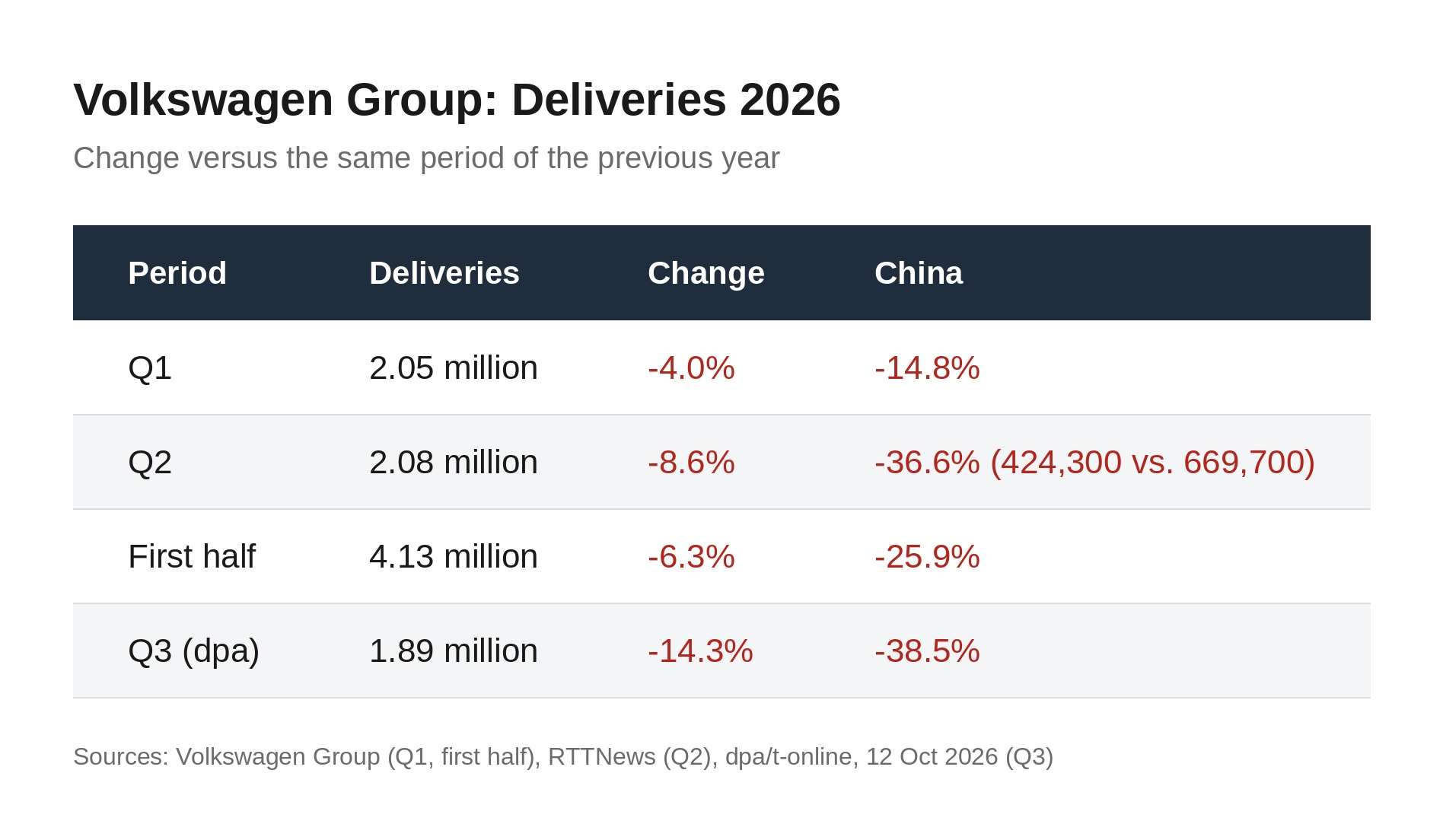
Taking China out gives a different picture for the first two quarters. In the second quarter, VW lost around 245,000 vehicles in China, while the group’s total decline was about 194,000. Outside China, deliveries were therefore a good 3 percent above the previous year. In the first quarter the figure was just under 1 percent, and for the half year about 2 percent according to the group. North America recovered in the second quarter (+7.7 percent), South America grew, and Western Europe edged up (+1.8 percent). The plus excluding China is, however, an average that conceals opposing movements: in Asia-Pacific excluding China, deliveries in the second quarter were 7.2 percent below the previous year, and in the Middle East and Africa 1.9 percent below. Until June, then, the situation was clear at its core: a shrinking Chinese market, in which local competitors take share from VW, pushed the group into the red, while the rest of the world held up on average, carried by North and South America with a slight gain in Europe.
The third quarter: a back-of-the-envelope calculation
The prior-year quarter was not weak. In the third quarter of 2025, VW had delivered around 2.2 million vehicles, an increase of 1.0 percent. A decline of 14.3 percent therefore corresponds to about 310,000 vehicles.
How much of this falls on China cannot be read from the dpa report, because the absolute figure for China in the third quarter of 2025 is missing. A rough estimate helps nonetheless. China’s share of the group’s deliveries was around 30 percent in the first half of 2025 and around 29.5 percent in the second quarter of 2025. If one assumes 30 percent for the third quarter of 2025 as well, a decline of 38.5 percent in China accounts for roughly 250,000 of the 310,000 missing vehicles. For the rest of the world, that would leave a decline of just under 4 percent.
The assumption naturally carries uncertainty. With a China share of 25 percent, the rest would stand at about -6 percent; at 35 percent, at about -1 percent. Only at a share of a good 36 percent would China explain the decline completely, and that would be considerably more than in the preceding quarters. The result is therefore not a measurement but a range. It suggests that in the third quarter VW lost ground outside China for the first time this year. This is not established until the group’s regional figures are available.
The same manufacturers, a different front
The second observation concerns Europe. Registration figures from recent months show a rapid rise of Chinese brands, in the very region that has so far been VW’s offset:
- In the EU, the share of Chinese brands from January to April was around 6 percent, up from 3.2 percent in the same period a year earlier, according to ACEA, the European Automobile Manufacturers‘ Association. In the wider European market including the United Kingdom and the EFTA countries, the figures were 7.3 percent, up from 3.7 percent.
- In August, according to the market research firm Dataforce, they reached a record share of 11.7 percent of EU registrations.
- The Center of Automotive Management (CAM), a German automotive research institute, puts market growth in Europe from January to August at 5.8 percent. Without the Chinese manufacturers, it would have been less than 1 percent.
- BYD registered 177,752 vehicles in the EU from January to August, an increase of 163 percent. Across Europe (EU, EFTA, United Kingdom), BYD, at 234,099 vehicles, was ahead of Tesla with 191,787 purely electric cars. BYD’s figure includes plug-in hybrids.
One point matters for interpretation. The growth of Chinese brands is less of an electric-vehicle phenomenon than the headlines suggest. In August, Chinese plug-in hybrid registrations tripled, while purely electric ones doubled. At BYD in Germany, plug-in hybrids accounted for 61.5 percent of registrations from January to August. The EU’s additional duties apply to purely electric cars; plug-in hybrids sidestep them. Local production adds to this: an analyst forecast expects around 90,000 vehicles of Chinese brands to be built in Europe in 2026, and BYD is building a plant in Hungary. This, too, reduces the effect of the duties.
In Germany itself, the share is still small. The Kraftfahrt-Bundesamt (KBA), Germany’s federal motor transport authority, counted 6.1 percent Chinese brands in September and 4.5 percent over the first nine months. In the United Kingdom, the figure for September was 23.3 percent, according to the industry association SMMT.
Beyond Europe
The development is not confined to Europe. In Brazil, VW’s most important market in South America, the share of Chinese brands in passenger-car registrations was 23.3 percent in June 2026, up from 10.2 percent in the same month a year earlier. BYD ranked fourth with just over 21,000 vehicles, while VW remained market leader with around 42,400 registrations. By comparison, over the first nine months of 2025 Chinese brands in Brazil had reached 9.1 percent, up from 6.8 percent in the same period a year earlier. The overall market grew by 33.8 percent in June. That explains why VW was still able to grow in South America in the first half, by 8.3 percent to 327,200 vehicles: a strongly growing market can mask a falling share. Whether VW has held its share in Brazil cannot be read from the available data.
In Mexico, Chinese brands grew 5.6 times faster than the overall market in the first quarter of 2026, according to AMDA (the Mexican automobile dealers‘ association) and INEGI (the national statistics institute); the market itself grew by 3.7 percent. Depending on the definition, their share is put at roughly 22 to 28 percent. In the report, VW is named among the established manufacturers losing ground, though without figures.
For Asia and the Middle East, group figures exist that point to similar conditions. According to an analysis by JATO analyst Felipe Muñoz, Chinese brands in 2025 held, among others, 32.4 percent market share in Thailand, 16.7 percent in Australia, 16.0 percent in the United Arab Emirates, 15.0 percent in South Africa, 12.2 percent in Indonesia and 11.8 percent in Saudi Arabia. It is precisely in these regions that VW was already losing in the second quarter: Asia-Pacific excluding China -7.2 percent, Middle East and Africa -1.9 percent. That is an indication, not proof, because the group’s figures name neither countries nor causes.
Several fronts, one process
Taken together, the observations suggest a reading. The manufacturers taking market share from VW in China are expanding at the same time in Europe, South America and other overseas markets. Two of the regions that offset the decline in China until June, Europe and South America, are thus target markets of the same expansion. Whoever is under price pressure in a shrinking home market looks for sales abroad. Europe is accessible for this: it is large, comparatively open, and the duties can be partly circumvented.
For VW, this means that the region that cushioned the decline in China until June is itself coming under pressure. In the EU, the group’s share from January to April was 26.7 percent, still by far the strongest position. However, VW’s registrations grew by 2.9 percent, more slowly than the market (+4.2 percent). By calculation, the share thus slipped slightly, from around 27.0 to 26.7 percent. The gap is small; the direction is not. If the overall market barely grows without the Chinese, their gains must come to a considerable extent from the established manufacturers. How this is distributed across individual brands will only be shown by registration figures by brand.
That Chinese expansion in Europe is a consequence of price pressure in the home market is an interpretation. The figures show only the simultaneity: a sharp decline for VW in China and a sharp rise of Chinese brands in Europe. The thesis is thus provisionally supported, not verified. It rests on two data series (group deliveries and registration statistics) that cannot be compared directly.
What speaks against it and what remains open
- Registrations are not deliveries. The statistics from ACEA, KBA and Dataforce count registrations, while VW reports deliveries to customers. The two measures diverge over the course of a month.
- The definition of a „Chinese brand“ is inconsistent. Depending on the source, the shares range from around 6 to over 11 percent. This probably depends on whether the EU or Europe as a whole is considered, and on whether groups such as Geely, with Volvo, Polestar and Smart, are counted.
- The data on third markets are heterogeneous. The Brazil figure is a monthly value based on new registrations; the country shares for Asia, Africa and the Middle East date from 2025 and come from an analysis without an explicitly named data source; the Mexico figures contradict each other in their definition. They show the direction, but not a reliable order of magnitude.
- VW is mounting a counter-offensive. On 11 October the group showed the „Electric Urban Car Family“ in Paris (ID. Polo, ID. Cross, Cupra Raval, Škoda Epiq), built on a shared platform with over 80 percent identical components. The European order backlog for purely electric cars stood more than 50 percent above its year-end level in mid-year. How quickly this translates into deliveries, and whether it secures market share against the Chinese, remains open.
- The regional figures for Q3 are missing. The estimate above does not replace them.
The next tests are two publications: VW’s original release on deliveries by region and brand, and the ACEA registration figures for September, due on 22 October. They will show whether VW’s European business actually weakened in the third quarter and from whom the Chinese brands took their gains.
On the source base: The foundation is the Volkswagen Group’s quarterly releases on deliveries for 2025 and 2026, the registration statistics of ACEA, KBA and SMMT as processed by news agencies and trade media, analyses by Dataforce and CAM, and my own back-of-the-envelope calculations. The calculations are marked as such.
Ralf Keuper
Sources
- t-online/dpa: Volkswagen verkauft erneut weniger Autos (12 Oct 2026, German)
- Volkswagen Group: Deliveries Q1 2026 (German)
- Volkswagen Group: Deliveries first half 2026 (German)
- Volkswagen Group: Deliveries to end of September 2025 (German)
- Volkswagen Group: Press releases, incl. „For Europe“ and Volkswagen Group Design (11 Oct 2026, German)
- RTTNews: Volkswagen Q2 Deliveries Fall 8.6% As China Sales Decline
- Euronews: Chinese carmakers double EU market share as EVs drive sales growth (27 May 2026)
- Lider: Registration data January to April 2026, shares of VW and Chinese brands
- autoevolution: Chinese Automakers Hit Record Market Share in Europe (Dataforce, August 2026)
- mezha.ua on the CAM analysis: Chinese manufacturers and market growth in Europe
- web.de: BYD überholt Tesla bei Europas Neuzulassungen (German)
- goodcarbadcar: Chinese brands in September 2026 in the UK and Germany (SMMT, KBA)
- ElektroQuatsch: Chinesische Marken bauen Europa-Fertigung hoch (German)
- Gasgoo: Brazil’s Passenger Vehicle Market in June, Chinese Brands‘ Share Rises to 23.3% (31 Jul 2026)
- Riviera Maya News: Chinese Car Brands Dominate Mexican Auto Market (19 Apr 2026, citing INEGI/AMDA)
- Motor1: Chinese Cars Are Dominating in Asia, Africa, and South America (Felipe Muñoz, JATO)
- drweb.de: BYD verdoppelt sich, chinesische Marken bei 6 % in der EU (German)