
In the third quarter of 2026, Audi delivered 314,905 vehicles worldwide, 19.7 percent fewer than a year earlier. In the second quarter the decline had still been around 8 percent. The company points to China, US tariffs and model changes for the A1 and Q2. Yet until June, Audi had held steady at last year’s level outside China, carried by a growing Europe. If one recalculates the third quarter from the available figures, that very business appears to have fallen by roughly a tenth. This essay separates what is documented from what is derived, and names the figure that could refute this reading.
The Announcement
On 12 October, Audi announced that its core brand delivered 314,905 vehicles to customers in the third quarter. Core brand means the Audi brand excluding Bentley and Lamborghini. „Deliveries“ counts vehicles handed over to end customers, not vehicles produced and not revenue.
The 19.7 percent decline follows a drop of around 8 percent in the second quarter. Over nine months the brand stands at 1.04 million deliveries, 11.4 percent below the previous year. In the third quarter of 2023 it was just under 480,000; today it is roughly a third lower.
Audi cites fierce competition and a weak market in China, US tariffs, which hit Audi particularly hard because, unlike BMW, it has no plant of its own in the United States, and the model changeover for the volume models A1 and Q2. In Germany and Europe Audi is slightly ahead after nine months, while in China it is down by almost a quarter and in the US by around a sixth.
This explanation is plausible. What remains open is whether it explains the third quarter or only the first nine months.
What the First Half Showed
In July, Audi presented its half-year figures. They are the last complete regional breakdown available:
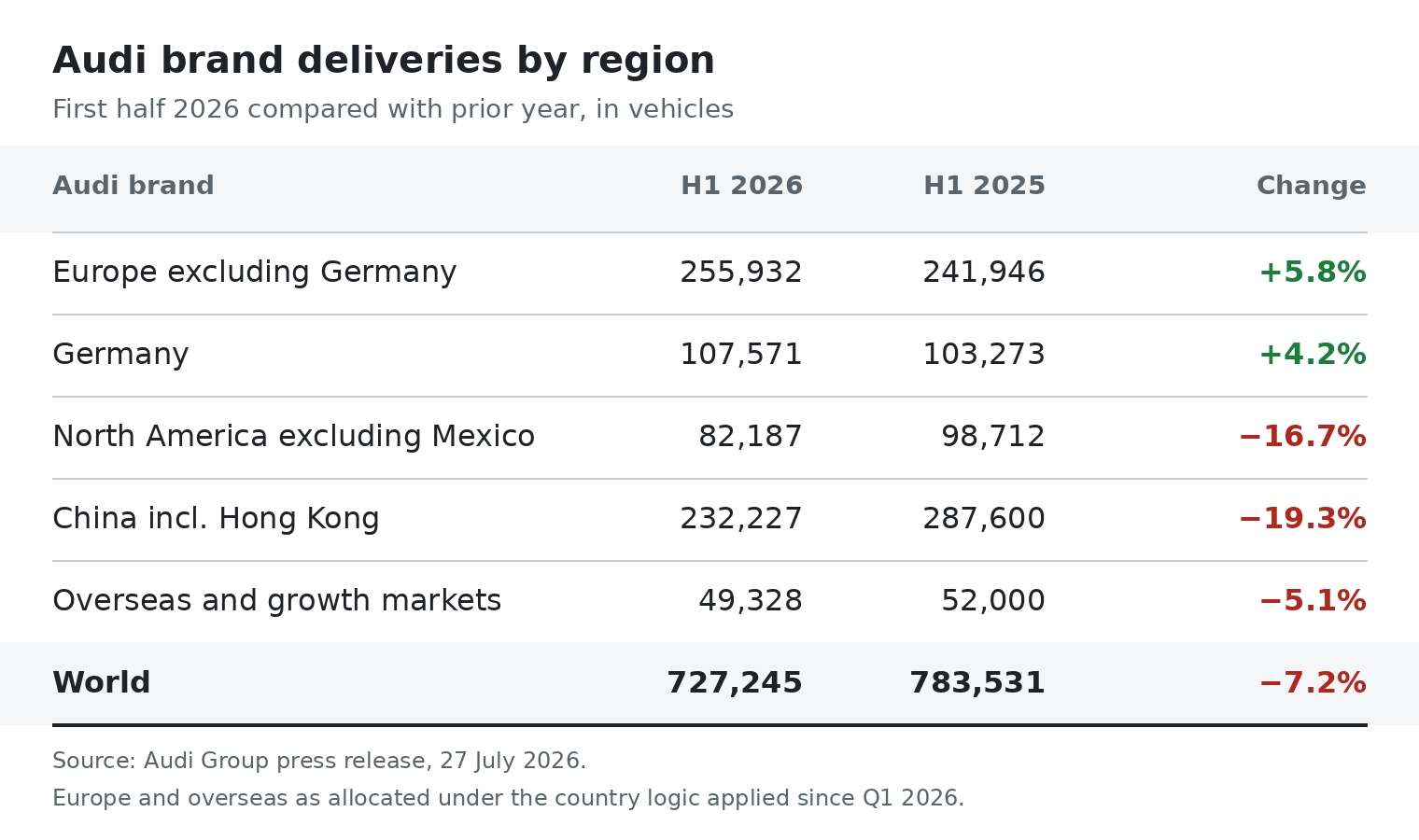
In July, the company itself drew a conclusion from these figures: outside China, business was significantly more robust, and global deliveries excluding China were close to the prior-year level. This statement can be recalculated from the table. If one subtracts China from the global total, 495,018 vehicles remain for the first half of 2026, against 495,931 the year before. That is a decline of 0.2 percent.
What is revealing is how this almost unchanged figure comes about. It is the result of an offset:

Of the decline of 56,286 vehicles, 55,373 fell on China, which is 98 percent. Outside China, Europe held the result: the gain of 18,284 vehicles not only offset the slump in North America (−16,525), it exceeded it by 1,759 vehicles. Only the small decline in overseas markets (−2,672) pushed the total excluding China slightly into negative territory. That the US did not weigh more heavily in the first half is therefore due to growth in Europe and not to a stable situation in North America itself.
Europe including Germany is not a peripheral item. With 363,503 vehicles it accounted for exactly half of all of the brand’s deliveries, while China, with 232,227 vehicles, accounted for just under a third (31.9 percent). Compared with the prior year (345,219), Europe grew by a good 5 percent. On the composition of this gain, Audi itself says: stable demand in Germany and in the other major markets, with Spain (+21 percent), Italy (+17 percent) and Great Britain (+10 percent) clearly above the prior year across all drivetrain types, so not only for electric or hybrid models.
Order intake adds to this. It counts orders placed before the vehicle is handed over and is therefore regarded as a leading indicator for deliveries. In Western Europe, it was 7 percent above the prior year across all drivetrains in the first half, and 117 percent higher for plug-in hybrids. That suggested that European demand would hold up in the second half as well.
Until June, then, Audi’s problem was at its core a China problem, plus a smaller one in the US that Europe offset. This is precisely the explanation the company offers for the third quarter as well.
The Calculation for the Third Quarter
Audi publishes quarterly figures only on a cumulative basis. Individual quarters therefore follow as differences: the third quarter of 2025 is the difference between nine months (1,175,765) and the first half (783,531), and the second quarter is the difference between the half-year and the first quarter. This allows the decline against the prior-year quarter to be expressed in vehicles:

In the second quarter, then, around 33,000 vehicles were missing compared with the prior year, and in the third quarter around 77,300. Within a single quarter, the decline grew by a good 44,000 vehicles (77,329 minus 32,991). These 44,000 are the acceleration to be explained. In what follows, „additional decline“ always refers to this increase.
China. For the first nine months of 2025, Audi reports around 434,000 deliveries in China. If one assumes „just under a quarter“ fewer for 2026, i.e. 23 to 25 percent, the third quarter comes to roughly 93,000 to 102,000 vehicles, against 146,400 the year before. That would be a decline of around 30 to 36 percent, after 26.6 percent in the second quarter. The decline in China thus grows from 38,000 vehicles in the second quarter to between 44,000 and 53,000 in the third. This increase of 6,000 to 15,000 explains only part of the additional decline of 44,000.
USA. Audi of America delivered 39,751 vehicles in the third quarter, against 38,030 in the second. The decline of around a sixth over nine months matches the first-half trend in North America. Measured against the second quarter (−6.8 percent), the quarter is nonetheless weaker, but it is not a new order of magnitude. From the rounded figures, the effect amounts at most to a mid-single-digit thousand.
China and the US together therefore explain a quarter to almost half of the additional decline of 44,000 vehicles. The remaining 23,000 to 33,000 are spread across Europe and the overseas and growth markets.
Outside China. If one subtracts the China estimate from the quarterly total, roughly 213,000 to 222,000 vehicles remain for the rest of the business, against 245,800 the year before. That is about 10 to 13 percent fewer, after practically zero in the first half. This result depends only on the China estimate, not on assumptions about Europe.
Europe. If Audi reports Europe including Germany as „slightly ahead“ after nine months, say 0 to 3 percent, the third quarter works out to 142,000 to 157,000 vehicles. The year before it was 160,000, which would be a decline of 2 to 11 percent. In the second quarter, Europe was still around 5 percent up. The swing thus amounts to 12,000 to 28,000 vehicles. That is the largest single item in the unexplained difference.
Why Europe Is the Point
If this calculation holds, the situation changed qualitatively in the third quarter. Until June, the decline could be located geographically, and there was one market that carried the business. Now this market is probably giving way as well. The statement that Audi is robust outside China, which was still accurate in July, probably no longer holds in October.
Audi itself offers one explanation: the model changeovers for the A1 and Q2. Both are compact models that probably made most of their volume in Europe. Junge Freiheit writes that production of both model lines will end in 2026. Audi has not confirmed this, and no unit figures for the two models are available. The half-year release announces the fully electric A2 e-tron as an entry model for the autumn, built in Ingolstadt. Whether it closes the gap, Audi does not say. The new Q9, the flagship, goes on sale in North America and Europe in the fourth quarter.
The figure thus lends some support to Audi’s own reading: part of the slump is a transitional gap. In my essay „Das Flaggschiff, das woanders gebaut wird“ („The Flagship Built Elsewhere“), I described the flight into the upper price segment as a well-worn practice of the German premium manufacturers: more power, more weight, higher price. The Q9 is its latest case. The third quarter shows the flip side. Anyone who launches at the top while phasing out at the bottom has no volume in the transition. Whether the calculation works out will be decided in the fourth quarter at the earliest.
A transitional gap does not explain, however, why the decline accelerates from 8 to almost 20 percent in a single quarter while China stays within its trend and the US does not collapse. In my essay „Der Ausgleich, der wegfällt“ („The Offset That Falls Away“), the question for the Volkswagen Group was whether Europe and other markets can absorb the shortfall in China. The Audi figures suggest that this offset reaches its limits here as well.
The Drivetrain Offsets Nothing
According to Anadolu, fully electric deliveries fell by 21.5 percent to 48,700 in the third quarter. This is a secondary source; the Audi table is not available. Arithmetically, the prior-year quarter was around 62,000. The share of total volume is thus around 15.5 percent, after around 15.8 percent. Electrification therefore does not offset the loss in volume; it falls away to the same degree. Where the decline sits is open. In the first half, Germany had still grown by around 23 percent in fully electric models and by 147 percent in plug-in hybrids.
What Carries the Result
In the first half, group revenue fell by 10.4 percent to 29.2 billion euros. Operating profit nevertheless rose slightly to 1,122 million euros, and the operating margin from 3.3 to 3.8 percent. Audi attributes this to strict cost discipline, lower provisions related to CO₂ regulation, and lower restructuring expenses. The China business’s contribution to the financial result shrank from 279 to 73 million euros.
In July, Audi lowered its forecast: revenue in 2026 is now expected between 58 and 63 billion euros (previously 63 to 68), and the operating margin between 5 and 7 percent. Chief Financial Officer Jürgen Rittersberger said that the measures already initiated were working but were not sufficient.
The arithmetic: to land at 5 percent for the full year, Audi must reach around 6 percent in the second half. At the revenue limits of the forecast, that is 1.8 to 2.0 billion euros of operating profit in six months, after 1.1 billion in the first half. Whether cost and provision effects can be repeated is open. That sales slumped by almost a fifth in the third quarter does not make it easier.
What Would Refute This Reading
The reading that the weakness in the third quarter has spread beyond China and the US, and that Europe is part of it, is provisionally corroborated. The back-calculation reproduces Audi’s own half-year statement (zero percent excluding China) and the quarterly total. But it rests on two rounded statements: „just under a quarter“ for China and „slightly ahead“ for Europe.
If the complete Q3 table shows Europe at or above the prior year, then the decline outside China sits in North America and the overseas and growth markets, and the Europe reading must be withdrawn. The question would then remain why North America and overseas together should bear a shortfall of this size. If the table shows Europe in the red, that is the news of the quarter: Audi’s last growing market has tipped.
On the Data
The source base consists of Audi’s group releases since early 2025 (nine-month, full-year, Q1 and half-year figures), the wire reports of 12 October, the release from Audi of America, and my own earlier pieces. Documented are: the Q3 total, the nine months, the half-year table including financial figures, and the US figure for Q3. Derived are: the Q3 value for China, the value outside China, the Europe value, the electric share, and the margin arithmetic for the second half. Since the first quarter of 2026, Audi has applied a new calculation logic that changes the allocation of individual countries to Europe and to the overseas and growth markets. For 2025, the values recalculated under this logic are used here. The total figures are not affected.
Ralf Keuper
Sources
- Audi Group: Half year 2026 (press release, 27 July 2026; German)
- Audi Group: First nine months 2025 (regional values recalculated under the new logic; German)
- Audi Group: First nine months 2025 (total figure 1,175,765)
- Audi Group: First quarter 2026 (German)
- Audi of America: Third quarter 2026 deliveries
- t-online/dpa-AFX: Sales of VW subsidiary Audi plunge by almost a fifth, 12 Oct 2026 (German)
- autohaus.de: Third quarter 2026: Audi sales plunge by almost a fifth (German)
- Anadolu via ua.news: Audi cuts global deliveries by 19.7% in third quarter (electric deliveries, secondary source)
- Junge Freiheit: Audi plunges further (end of A1/Q2 production, not confirmed by Audi; German)
- My own earlier pieces on EconLittera: „Das Flaggschiff, das woanders gebaut wird“; „Der Ausgleich, der wegfällt“