
China’s car industry is beginning to consolidate. Nio and Geely are merging their battery-swapping businesses, and GAC is taking over half of FAW Toyota. At first glance, this looks like the long-awaited market shake-out, one that might also relieve the pressure on Europe. On closer inspection, however, the shake-out hits mainly the joint-venture plants of foreign carmakers, while China’s domestic brands shift their surplus into exports. For Europe, this creates an uncomfortable asymmetry: in China, overcapacity is exported; in Europe, it is shut down.
The occasion
On 28 September 2026, The New York Times reported on two transactions it read as a sign of consolidation beginning in China’s overcrowded car industry. The electric carmaker Nio and the Geely group (Zhejiang Geely Holding) are combining their subsidiaries for battery swapping and charging. Two weeks earlier, the state-owned carmaker GAC (Guangzhou Automobile Group) had announced plans to take a stake, via a share issue, in a joint venture of the likewise state-owned group FAW (First Automotive Works). The diagnosis quoted by the paper is unambiguous: China simply has too many carmakers, and mergers and acquisitions will be the trend of the coming years.
The diagnosis is correct. The conclusion it seems to suggest is not self-evident. Consolidation does not automatically mean that production capacity leaves the market. And even where it does, what matters is which capacity leaves.
Combining without converging: Nio and Geely
In battery swapping, an electric car drives into an automated station where the depleted battery in the vehicle floor is exchanged for a charged one. The process takes three to four minutes, considerably less than a fast charge to 80 percent. Nio has spent years building this model into its trademark and operates China’s largest swapping network. The downside: stations require heavy upfront investment in land, grid connections and equipment, and only pay off at high throughput.
The terms of the deal show what is at stake. According to Nio’s filing with the US Securities and Exchange Commission, a Geely subsidiary is contributing its swapping company Yiyi, which mainly serves taxi and ride-hailing fleets, plus 640 million yuan in cash to NIO Power, and receives 30 percent in return. Nio retains control with 63.6 percent; the unit is valued at around 16 billion yuan, roughly 2.4 billion dollars. In return, Nio takes 10 percent of Geely’s charging company Haohan Energy, which in turn uses the money to buy charging assets from Nio. In effect, Nio is trading part of its charging network for a stake in its partner’s.
Two details qualify the picture of a firm alliance. First, Geely’s stake is tied to performance targets: it can fall to 20 percent if targets are missed, or rise to 34 percent with a further payment of 640 million yuan. Second, the truly far-reaching component, aligning Geely’s passenger car models with Nio’s swapping standard, has so far been agreed only as a „preliminary plan“. The history counsels caution: back in November 2023, the two companies had announced a partnership with common standards, without capital and without visible consequences. Stephen Dyer, head of the Asia automotive practice at the consultancy AlixPartners, points out in The New York Times how deeply a swapping standard intrudes into vehicle design. That is precisely why Chinese carmakers have discussed common standards for more than a decade without implementing them.
The core of the deal is a matter of business economics: an expensive network is to be better utilised through additional users. For Nio, selling a minority stake brings capital and a valuation benchmark. It changes nothing about the loss-making vehicle business. Geely, for its part, secures an option on a standard without committing to it. All of this has little to do with cutting vehicle capacity.
The shake-out hits the joint ventures: GAC and FAW Toyota
The second case is different. Since 28 September it has been official what had previously only been suspected: GAC intends to acquire FAW’s 50 percent stake in FAW Toyota, paid for with newly issued shares at 5.75 yuan each. FAW thereby becomes GAC’s second-largest shareholder; the controlling owner remains the state-owned assets administration of the city of Guangzhou.
To understand the significance, one needs the background. Since the 1980s, foreign carmakers wishing to produce in China had to form joint ventures with Chinese partners, usually on a fifty-fifty basis. Toyota still operates two separate structures: FAW Toyota in the north and GAC Toyota in the south, which compete with each other. After the transaction, GAC would have access to both.
The pressure behind the deal is considerable. FAW Toyota sold a good 273,700 vehicles from January to August 2026, 27.4 percent fewer than a year earlier. The business magazine Caixin frames the move as consolidation ahead of an expected further market contraction of 10 to 20 percent by 2027. What matters is GAC’s announcement: coordination of development, supply chains, production sites and sales across both Toyota joint ventures, in order to avoid duplicate investment. Here, plants are genuinely up for disposition.
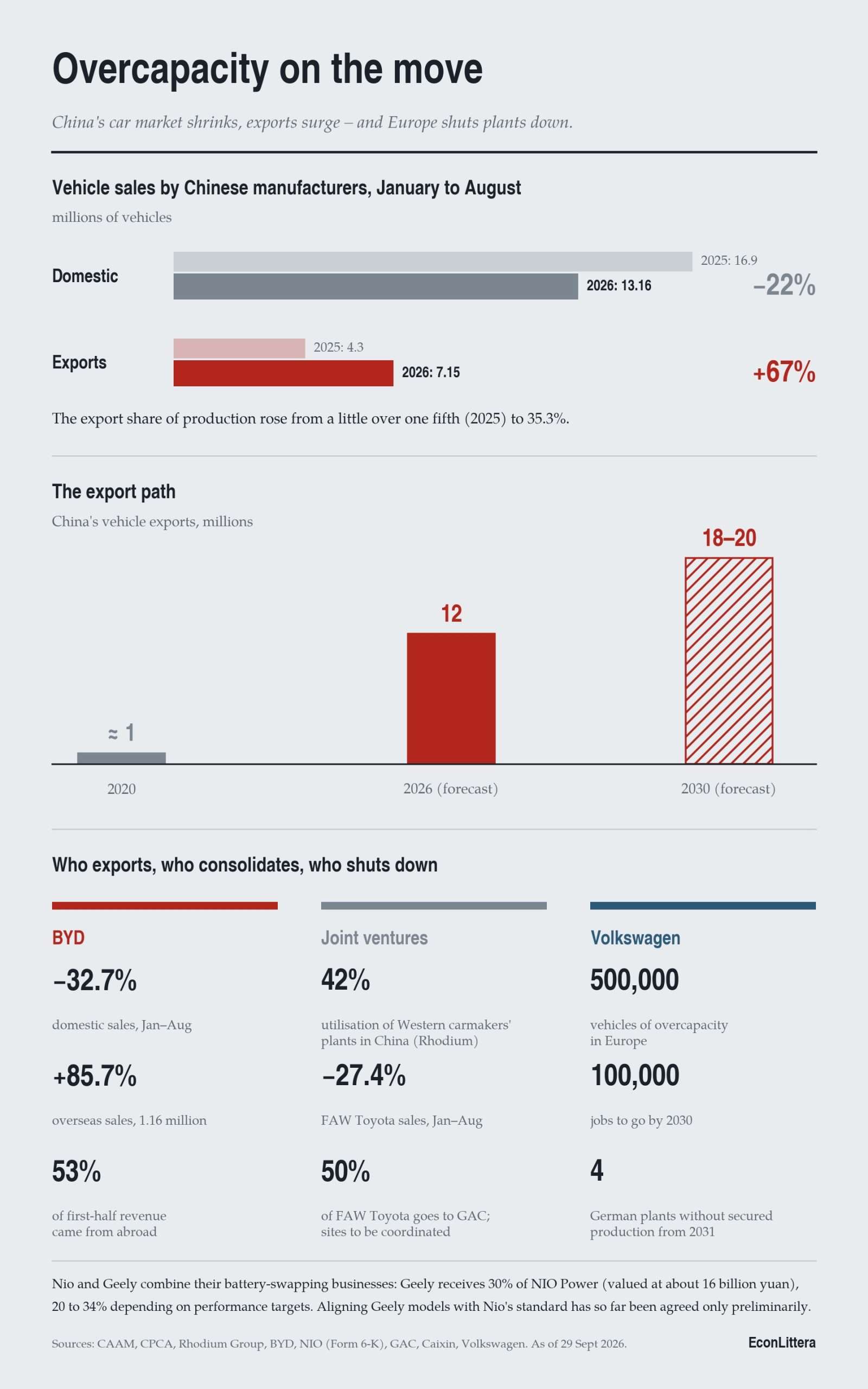
This fits a finding that often gets lost in the debate about Chinese overcapacity: the overcapacity is unevenly distributed. The Rhodium Group, a US economic research firm, locates a large part of it in the joint ventures of Western carmakers, whose plants, with more than 22 million units of capacity, run at only 42 percent utilisation. Averages conceal this. Official statistics show utilisation of 70.6 percent for the first half of 2026, but measure output value against estimated capacity. On the basis of nameplate capacity, which the industry data provider Gasgoo estimates at around 55 million passenger cars, utilisation would be closer to 47 percent. Even within a single group the figures diverge widely: at the carmaker Great Wall, one plant ran at more than twice its nameplate capacity, another at 16 percent. The plants standing idle are above all those lacking a product in demand, and these are frequently the plants of foreign joint ventures whose combustion-engine models are losing buyers.
The domestic market shrinks, exports grow
Market data confirm the scale of the slump. According to the CPCA, China’s passenger car association, 11.7 million passenger cars were sold at retail in the first eight months of 2026, 20.8 percent fewer than in the same period a year earlier. For the full year, a decline of just under 15 percent is expected. The New York Times attributes the decline to consumer spending depressed by falling housing prices and speaks of a market that has been shrinking since 2017. That explanation falls short. The market still reached total sales of 23.29 million vehicles in 2024, and the current slump coincides with a high prior-year base and the expiry of subsidies and tax exemptions for electric vehicles at the end of 2025. The structure of the decline is revealing: combustion-engine cars lost around 40 percent, vehicles with electric or plug-in hybrid drive only a little over 10 percent.
The domestic slump is matched by an export surge. Exports rose by 67 percent to 7.15 million vehicles in the first eight months, while domestic sales fell by 22 percent. The share of exports in production climbed from a little over one fifth in 2025 to 35.3 percent. The CPCA expects 12 million vehicles to be exported this year and 18 to 20 million by 2030.
The pattern shows most clearly at the market leader. BYD sold a little over 1.5 million vehicles domestically from January to August, 32.7 percent fewer than a year earlier. Globally, sales were down only just under 7 percent, because overseas sales rose by 85.7 percent to 1.16 million units. In the first half of the year, BYD already generated 53 percent of its revenue outside China. Geely pursues a different strategy, running combustion-engine and electric models side by side, which cushioned the domestic decline, but it shows the same pattern: in August, domestic sales fell by over 25 percent while exports tripled.
The price war at home has consequences beyond the carmakers themselves. In 2023 and 2024, BYD and Geely paid their suppliers on average only after around 150 days, Western carmakers after 40 to 60 days. Beijing is fighting this practice as part of its campaign against „involution“. In China, the term describes ruinous competition in which companies lose earnings despite growing volumes. Seventeen carmakers committed in 2025 to payment terms of no more than 60 days, and in June 2026 the rule was extended to the battery industry. That The New York Times still reports late payments suggests enforcement remains patchy.
The asymmetry
Putting the findings together yields the following picture. Consolidation in China starts where utilisation is weakest: at the joint ventures of foreign carmakers. The large domestic brands respond to the shrinking home market not by cutting capacity but by exporting. If the reported overcapacity in China falls, this therefore does not mean that pressure on world markets eases. It may even rise.
On the European side, Volkswagen illustrates the opposite movement. At the beginning of September, its supervisory board approved the elimination of a further 50,000 jobs, doubling the target to a total of 100,000 by 2030, around 15 percent of the global workforce. The group puts its European overcapacity at 500,000 vehicles above current demand. For the plants in Emden, Zwickau, Hanover and Neckarsulm, a competitive production allocation for the years 2031 to 2034 is not secured. Chinese competition is only one cause among several. Volkswagen also cites high energy prices, US tariffs and the costly transition to electric drive.
The asymmetry is nonetheless clear. In China, the overcapacity of domestic brands is carried into foreign markets via exports; in Europe, overcapacity is shut down. Moreover, the cutbacks in China hit first the plants in which foreign carmakers hold stakes. With the reorganisation, Toyota loses its independent dual structure, and for Volkswagen, which also runs a joint venture with FAW, the question has merely been deferred.
The instrument handed back
In this context, a side note in the NYT report gains weight. The EU is considering requiring Chinese electric carmakers to form joint ventures when they invest in Europe. Behind this wording lies the Industrial Accelerator Act, a legislative proposal presented by the European Commission in March 2026. For investments in batteries, electric vehicles, photovoltaics and critical raw materials, it provides for technology transfer obligations, caps on foreign ownership, and requirements for local value added and employment. The rules apply only to investors from third countries that account for more than 40 percent of global capacity in the sector concerned. China’s Ministry of Commerce spoke of serious investment barriers and institutional discrimination.
The irony is obvious: the EU is reaching for the instrument with which China extracted foreign know-how for decades. Two findings complicate it, however. China officially abolished its own joint-venture requirement in 2022, at a time when its carmakers no longer needed what they had learned. And a study commissioned by the environmental organisation Transport & Environment found no long-term transfer of skills in existing European-Chinese battery partnerships, such as those between Volkswagen and Gotion or Stellantis and CATL. There, cooperation served mainly to secure battery supply in the short term. A joint venture does not transfer knowledge by itself. In China it worked because the state made market access conditional on it, because the market was large enough to justify that price, and because the Chinese side wanted to learn and was able to. Whether these conditions exist in Europe is an open question.
The next stage is imminent. EU Trade Commissioner Maroš Šefčovič travels to Beijing in October, and the EU summit on 15 October serves as the political deadline for „tangible results“ from the trade talks under way since June. The Commission is pressing for voluntary export restraints on electric cars, which China’s commerce minister rejected at the beginning of September.
What remains open
The thesis that China’s consolidation clears out the joint-venture layer while domestic brands export their surplus is at best provisionally corroborated. It rests on Rhodium’s distribution of utilisation, on a single concrete case with announced site coordination, and on the export development of the two largest domestic brands. Nothing is yet known about the actual site decisions at FAW Toyota.
Three developments would weaken the thesis: plant closures at Chinese domestic brands rather than only at joint ventures, an agreement in October that actually limits exports, or a collapse in exports due to trade barriers in other destination markets. If none of these occurs, Europe must expect that the shake-out of the Chinese market will not relieve its own adjustment pressure, but shift it.
Ralf Keuper
Related essays on EconLittera (in German)
- Lage der deutschen Industrie – zwischen Bestands- und Flussgrößen
- Wie BYD auch bei zunehmendem Wettbewerb die Marge hält
Sources
- The New York Times: report on the merger of Nio’s and Geely’s charging and battery-swapping businesses, 28 September 2026
- NIO Inc., Form 6-K, Exhibit 99.1 (28 September 2026): https://www.sec.gov/Archives/edgar/data/0001736541/000110465926111125/tm2626448d1_ex99-1.htm
- Bloomberg: Geely To Buy 30% Stake in Rival Nio’s Battery-Swapping Unit: https://www.bloomberg.com/news/articles/2026-09-28/geely-to-buy-30-stake-in-rival-nio-s-battery-swapping-unit
- Gasgoo: Geely Invests in NIO Energy, Expanding Cooperation in Charging and Battery Swapping: https://autonews.gasgoo.com/articles/ev/geely-invests-in-nio-energy-expanding-cooperation-in-charging-and-battery-swapping-2104778132065574912
- Electrek: NIO sells 30% of battery swap unit to Geely: https://electrek.co/2026/09/27/nio-power-geely-30-stake-battery-swap-rmb16-billion/
- Xenospectrum: NIO and Geely Merge Battery-Swap Businesses: https://xenospectrum.com/en/nio-geely-battery-swap/
- Finimize: NIO And Geely Team Up On Battery Swapping: https://finimize.com/content/nio-and-geely-team-up-on-battery-swapping
- 24/7 Wall St.: Nio Advances 3% as Geely Takes 30% Stake: https://247wallst.com/investing/2026/09/28/nio-advances-3-as-geely-takes-30-stake-in-battery-swapping-unit-xpeng-and-tesla-pull-back/
- CnEVPost: GAC plans to buy 50% of FAW Toyota: https://cnevpost.com/2026/09/28/gac-to-buy-50-faw-toyota-coordinate-toyota-china-jvs/
- Caixin Global: FAW-GAC Deal Tests a New Path for China’s Auto Consolidation: https://www.caixinglobal.com/2026-09-28/in-depth-faw-gac-deal-tests-a-new-path-for-chinas-auto-consolidation-102489282.html
- China EV Home: GAC Group Set to Acquire 50% Stake in FAW Toyota: https://chinaevhome.com/2026/09/29/gac-group-set-to-acquire-50-stake-in-faw-toyota/
- electrive.net: GAC will 50 Prozent an FAW Toyota übernehmen: https://www.electrive.net/2026/09/29/gac-will-50-prozent-an-faw-toyota/
- Caixin Global: China’s Passenger Car Sales Slump 24% in August: https://www.caixinglobal.com/2026-09-09/chinas-passenger-car-sales-slump-24-in-august-102483307.html
- Yahoo Finance: Chinese vehicle sales decline 5% in August: https://finance.yahoo.com/economy/articles/chinese-vehicle-sales-decline-5-113418329.html
- Focus2move: Chinese Auto Market 2026: https://www.focus2move.com/chinese-auto-market/
- Best Selling Cars Blog: China wholesales August 2026: https://bestsellingcarsblog.com/2026/09/china-wholesales-july-2026-fang-cheng-bao-111-8-leapmotor-65-9-ignore-market-down-23-7/
- Hello China Tech: What Happens to a Chinese Car Factory When It Loses Its Product: https://hellochinatech.com/p/china-auto-factory-overcapacity
- Rhodium Group: Why Are Chinese EVs So Cheap?: https://rhg.com/research/why-are-chinese-evs-so-cheap/
- CnEVPost: BYD August sales rise 17.8%: https://cnevpost.com/2026/09/01/byd-aug-2026-sales/
- CarNewsChina: BYD made 53% of its revenue overseas: https://carnewschina.com/2026/09/01/byd-made-53-revenue-overseas-as-chinas-sales-crumble/
- CnEVPost: Geely’s August sales rise 8%: https://cnevpost.com/2026/09/02/geely-aug-2026-sales/
- Global China EV: Geely dethroned BYD in January sales: https://www.globalchinaev.com/post/geely-dethroned-byd-in-january-sales-as-nev-penetration-craters-to-44-in-chin
- Global Times: Major Chinese automakers pledge to make supplier payments within 60 days: https://www.globaltimes.cn/page/202506/1335887.shtml
- Anadolu Agency: China extends 60-day supplier payment cap to EV, energy storage battery sector: https://aa.com.tr/en/asia-pacific/china-extends-60-day-supplier-payment-cap-to-ev-energy-storage-battery-sector/3981896
- AP/Yahoo Finance: Volkswagen board approves cutting 50,000 more jobs: https://finance.yahoo.com/economy/policy/articles/volkswagen-board-approves-50-000-201336043.html
- UPI: Volkswagen to cut 50,000 jobs as part of restructuring plan: https://www.upi.com/Top_News/World-News/2026/09/03/germany-volkswagen-job-cuts-autos/4201788476777/
- CNBC: Volkswagen plans 50,000 job cuts: https://www.cnbc.com/2026/09/04/volkswagen-job-cuts-tariffs-china.html
- MOFCOM: Spokesperson’s Remarks on the EU Industrial Accelerator Act: https://english.mofcom.gov.cn/News/SpokesmansRemarks/art/2026/art_6ba67ba24946452099098f1c83e3f408.html
- Centre for European Reform: Europe’s door to Chinese tech investment is still ajar: https://www.cer.eu/insights/europes-door-chinese-tech-investment-still-ajar
- InsideEVs: Europe To China: Want Subsidies? Hand Over Your Technology: https://insideevs.com/news/741554/eu-china-jv-transfer-future/
- Transport & Environment: No tech transfer requirements in Chinese-European battery partnerships: https://www.transportenvironment.org/articles/no-tech-transfer-requirements-in-chinese-european-battery-partnerships-despite-eu-subsidies-study
- Euronews: EU officials to travel to China as October deadline looms: https://www.euronews.com/my-europe/2026/08/25/euronews-exclusive-eu-officials-to-travel-to-china-as-october-deadline-for-trade-rebalanci
- IndexBox: EU and China Negotiate Import Quotas as October Deadline Looms: https://www.indexbox.io/blog/eu-and-china-negotiate-import-quotas-as-october-deadline-looms/
- EU Insider: Brussels Gives China Until October: https://www.euinsider.eu/news/eu-china-trade-october-deadline-2026